
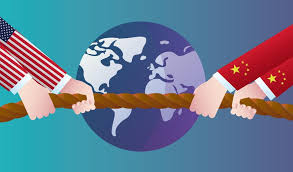
America was once renowned worldwide as the greatest superpower, but today, China is steadily positioning itself to take over that role. Through political indecision, weakened borders, and a retreat from multilateralism, the U.S. is creating a leadership gap that China is eagerly awaiting to fill. This gap grows larger every day, making it the biggest issue in the world today. Unless the U.S. reclaims a posture of unity, strength, and stability, we risk ceding the title of global superpower to the Chinese Communist Party and with it, the freedoms of the American people.
But why should we, as Americans, care if China replaces the U.S. as the global superpower? The implications go further than a shift in economic status or threats to national security. China’s rise threatens the very values America has fought for: freedom, human rights, and democratic governance. A world shaped by China’s communist ideals would look significantly different from the one guided by democratic ideals today. China’s leadership depends on state control, suppression, and authoritarianism. If America cedes power to China, it risks these values becoming the new normal, weakening democratic governments and empowering authoritarian regimes around the world. If the U.S. fails to reclaim its position, it won’t just impact its own citizens but harm global security and impact human rights worldwide.
True global leadership begins at home. A nation riddled with political uncertainty, cultural division, and uncontrolled migration can’t project strength and confidence abroad. China sees our internal disorder – rising partisanship, strained border security, and social fragmentation – and interprets it as a national decline.
Since President Trump’s term, the U.S. has begun a significant review of many multinational treaties, alliances, and agreements. While reviews are warranted when a new administration takes over, the broader trend leads towards disengagement – ambiguity towards NATO, skepticism of the United Nations, and the World Trade Organization, and complete withdrawal from the Paris Agreement have weakened America’s credibility. This existing void has allowed China to expand its influence, especially across the developing world.
China has expertly capitalized on America’s retreat from global leadership. As the United States reduces foreign aid and increases threats of withdrawal from global agreements, China has created new initiatives to directly counter America’s withdrawals. For example, through the Belt and Road Initiative (BRI), China has poured billions into infrastructure projects across Asia, Africa, and Latin America. China has been building ports, railways, and digital networks that secure both economic leverage and political loyalty. By endlessly debating the foreign aid budget and dissolution of USAID, the United States has allowed China to successfully win the loyalty of developing nations reshaping how countries vote, regulate technology, and govern their people, often in ways that depart from traditional American democratic values.
China’s advantage lies in its economic power and long-term strategic vision due to its communist rule. While Western democracies struggle with shifting administrations and long-
term strategies, China’s centralized system allows for consistent policies and global outreach. China’s growing control over supply chains, rare earth minerals, and manufacturing has made its contributions indispensable to the global economy. This power has allowed China to advance in its goals to expand global power and become the next global superpower.
America’s growing cultural division and increased partisanship have made transitions between administrations more abrupt and unpredictable than ever before. Shifting foreign policy every four years from one extreme to the other has made U.S. leadership seem unreliable as a long-term global partner. This has impacted topics such as climate change, technology regulation, and trade, with inconsistencies undermining U.S. commitments. American allies are growing worried and have started to build parallel alliances with China through the BRI and the Asian Infrastructure Investment Bank. This has strengthened China’s foreign strategy, projecting an image of stability and partnership. This perception, however misleading, allows the Chinese Communist Party to cast itself as the leader of the “new world order” where power is no longer centered around the United States.
One of America’s greatest strengths has always been strong alliances, including NATO, AUKUS, and G7. Alliances such as these threaten China’s ability to grow as a global power and have been a main deterrent for a global conflict between the United States and China. These alliances depend solely on trust. Without it, deterrence weakens. Unfortunately, America’s internal conflict and unpredictability have eroded that trust.
Although the United States is creating gaps for China to fill, China is not without its own internal and global difficulties. China’s once-growing real estate sector is crumpling under massive debt, youth unemployment is at an unprecedented level, and their concerning birth rate threatens long-term efficiency. These challenges expose major deficiencies in China, leading the world to question whether China is truly ready to fill America’s role as the global leader.
The world isn’t necessarily willingly choosing China over the United States as the global superpower. The world is simply reacting to America’s gaps in foreign aid, inconsistencies in global policies, and evident internal conflict. The longer the United States fails to demonstrate a coherent vision backed by domestic stability, the more we push the world to accept China as its next global power. To solidify America’s rightful place as the world’s true superpower, we must rebuild trust at home and abroad. By focusing on long-term foreign strategy, rebuilding national unity, and tightening our borders, America can begin to heal from the inside out. Otherwise, we will be forced to face a world where values, freedom, and democracy are no longer at the center of the world. This wouldn’t be just an American loss. It would be the world’s.

Leticia Larson , MPP '27 , Generalist
Leticia Larson is a graduate student at Duke University’s Sanford School of Public Policy, with a focus on National Security and Foreign Policy. Her research interests lie in international relations, use of nuclear weapons, and conflict management. As an immigrant with a background in government work, Leticia brings an interdisciplinary perspective to questions of national security and international relations.